Home / Destinations / Car Shipping to India
Car Shipping to India — International Vehicle Transport to Mumbai, Chennai & Kolkata
Shipping a car to India costs from £1,360 via dedicated container to Nhava Sheva (Mumbai), with sea transit of approximately 22–26 days. RORO and container shipping are both available. India imposes some of the highest vehicle import duties in the world — Basic Customs Duty of 60%–100% of CIF value, plus 28% GST, GST Compensation Cess, and Social Welfare Surcharge, meaning the total tax burden on a standard vehicle frequently exceeds its purchase price. Used vehicles must generally be under 3 years old for standard import. The Transfer of Residence (ToR) scheme offers duty concessions for qualifying returning residents relocating permanently to India. A licensed Indian customs broker is essential on this route.
Frequency of Sailing
Monthly/ Weekly
Transit Time
40 Days
Methods
RORO & Container
Cost Starts From:
£1,298
What Shipping Methods Are Available to India?
Both RORO and container shipping serve India’s major vehicle import ports, with the right choice depending on vehicle type, condition, and whether personal effects need to travel alongside.
RORO to Nhava Sheva or Chennai
RORO is available for standard roadworthy vehicles. Your vehicle is driven directly onto a purpose-built car carrier vessel and secured for the voyage. Electric and plug-in hybrid vehicles are not permitted on RORO services. No personal belongings may be placed inside the vehicle on RORO shipments — the vehicle must be completely empty at loading.
Dedicated Container to Nhava Sheva, Chennai or Kolkata
Container shipping is available for all vehicle types including non-runners, classic cars, luxury vehicles, and electric vehicles. Your vehicle is loaded into a private 20ft steel container for the full duration of the voyage, providing maximum protection against the elements. Personal belongings and spare parts can be included alongside the vehicle in a dedicated container, subject to Indian import regulations and full declaration.
Which Indian Ports Handle Vehicle Imports?
Four major ports serve international vehicle shipments into India, each positioned for a different region of the country:
| Port | Also Known As | Best For | Approx. Transit |
|---|---|---|---|
| Nhava Sheva | JNPT, Mumbai | Mumbai, Maharashtra, North India | 22–26 days |
| Chennai | Madras | Tamil Nadu, South India, Bangalore | 24–28 days |
| Kamarajar Port | Formerly Ennore | North Chennai, industrial shipments | 24–28 days |
| Kolkata | Calcutta | West Bengal, Northeast India | 26–30 days |
Nhava Sheva is India’s primary vehicle import hub and the most commonly used entry point for personal vehicle imports. Select your destination port based on where the vehicle will ultimately be registered and used within India.
How Much Does It Cost to Import a Car to India?
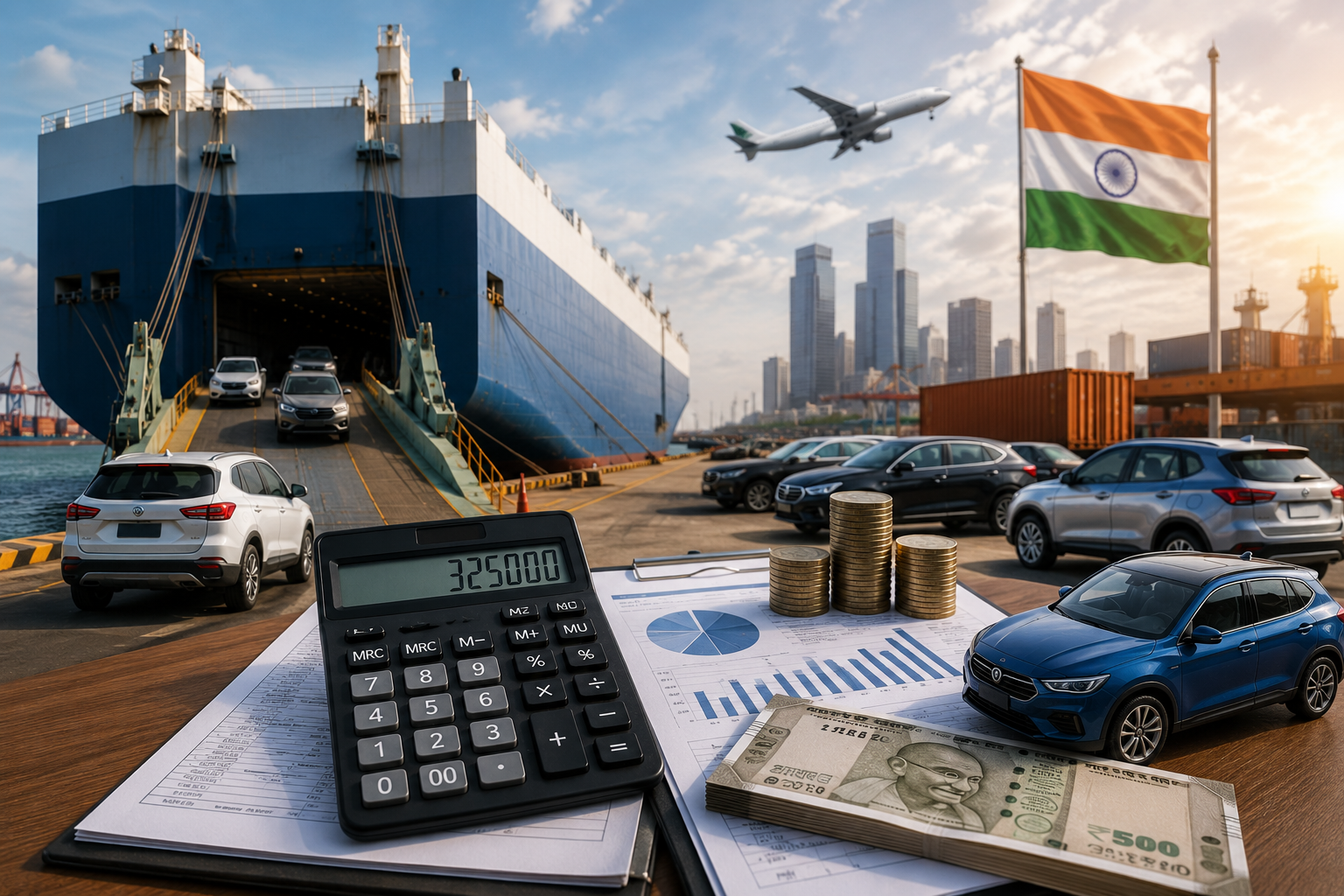
India imposes some of the highest vehicle import duties of any country in the world. The sea freight cost is only a small fraction of the total landed cost on this route.
Import Duty and Tax Structure
| Tax Component | Rate | Applied To |
|---|---|---|
| Basic Customs Duty (BCD) | 60%–100% of CIF value | Varies by engine size and vehicle type |
| Social Welfare Surcharge | 10% of BCD | Applied on top of Basic Customs Duty |
| GST | 28% | CIF + BCD + Social Welfare Surcharge |
| GST Compensation Cess | 20%–22% | CIF + BCD + Social Welfare Surcharge |
Illustrative Duty Calculation (Vehicle CIF Value £15,000)
| Component | Rate | Amount |
|---|---|---|
| Basic Customs Duty (100%) | 100% of £15,000 | £15,000 |
| Social Welfare Surcharge (10% of BCD) | 10% of £15,000 | £1,500 |
| GST (28% on £31,500) | 28% | £8,820 |
| GST Compensation Cess (20% on £31,500) | 20% | £6,300 |
| Total duty and tax | ~£31,620 |
On a £15,000 vehicle, the total duty burden is approximately £31,620 — more than double the vehicle’s purchase price. These figures are illustrative only. Actual calculations depend on the INR/GBP exchange rate at the time of import, exact tariff classification under CBIC schedules, and engine capacity. Always verify with a licensed Indian customs broker before committing to shipment.
What Is the Transfer of Residence (ToR) Scheme?
The Transfer of Residence (ToR) scheme is India’s primary concession route for individuals permanently relocating to India who wish to import a vehicle at reduced or nil duty. It is administered by the Directorate General of Foreign Trade (DGFT).
ToR Eligibility Requirements
To qualify for ToR duty concessions, all of the following conditions must be met:
- You must have resided abroad for a minimum of two consecutive years immediately prior to relocation
- The vehicle must have been owned and used by you overseas for at least one year before the date of import
- An Import Licence from the DGFT must be obtained before the vehicle is shipped — it cannot be applied for retrospectively
- The vehicle must generally be new or under 3 years old at the time of import
- You must be returning to India permanently — not on a temporary or visit basis
Even under ToR, GST and other levies may still apply. The duty concession reduces — but does not always eliminate — the total tax burden. Applications are complex and must be submitted to the DGFT with supporting documentation. Engage a licensed Indian customs broker before beginning the ToR application process.
Vehicle Age Limit for Importing Into India
India enforces strict vehicle age limits for personal imports. Used vehicles older than 3 years from the date of manufacture are generally not permitted for standard personal import. Even vehicles within the 3-year window attract very high duties. New vehicles are the preferred import category under Indian trade policy, which is structured to protect domestic manufacturing.
Temporary import is permitted only under very specific circumstances — international motor rallies, exhibitions, or diplomatic use — and requires special authorisation from the DGFT and Customs Department with strict re-export conditions attached.
How Car Shipping Worldwide Manages Your India Shipment
Shipping a vehicle to India is not a route to approach without preparation. The duty burden is substantial, the age restrictions are strict, and the ToR application process must be completed before the vessel sails — not after arrival. Car Shipping Worldwide coordinates every stage of the process to ensure nothing is missed and no avoidable costs arise at the destination port.
Origin Country — Before the Vessel Sails
We confirm your vehicle's eligibility under Indian import rules, assess whether the Transfer of Residence scheme applies to your situation, manage all origin export documentation, and ensure your DGFT Import Licence is confirmed before any sailing date is booked. No vessel is confirmed until every pre-shipment requirement is in place.
Sea Freight — Dedicated or Shared Container
We match your vehicle to the correct shipping method and Indian destination port — Nhava Sheva for Mumbai and North India, Chennai for South India, or Kolkata for the East. Dedicated container from £1,360 for a standard car, £1,577 for a large vehicle. All booking, documentation, and Bill of Lading are managed on your behalf with monthly sailing frequency.
Indian Destination — Customs Clearance & RTA Registration
We coordinate with our appointed agents at Nhava Sheva, Chennai, and Kolkata, providing any documentation or clarification required to support the customs clearance process on your behalf. We remain available throughout to ensure the process at the destination moves forward without unnecessary delays.
Frequently Asked Questions: Car Shipping to India
How much does it cost to ship a car to India?
Dedicated container shipping to Nhava Sheva (Mumbai) starts from £1,360 for a small car and £1,577 for a large vehicle, port-to-port. India’s import duty stack — Basic Customs Duty (60%–100% of CIF), Social Welfare Surcharge (10% of BCD), GST (28%), and GST Compensation Cess (20%–22%) — typically adds more than the vehicle’s purchase price to the total landed cost. Always obtain a full duty calculation from a licensed Indian customs broker before committing.
How long does shipping a car to India take?
Sea transit to Nhava Sheva (Mumbai) takes 22–26 days via RORO and 30–40 days via dedicated container. Chennai takes 24–28 days; Kolkata 26–30 days. Allow an additional 7–14 working days for customs clearance and port release after vessel arrival.
What is the vehicle age limit for importing a car to India?
Used vehicles must generally be under 3 years old from the date of manufacture for standard personal import. Vehicles older than 3 years are not permitted under standard import rules. Even vehicles within the age limit attract very high import duties. The Transfer of Residence scheme has its own age eligibility criteria — verify with a licensed customs broker before shipping.
What is the Transfer of Residence (ToR) scheme?
The ToR scheme allows individuals permanently relocating to India to import one vehicle at concessional duty rates if they have resided abroad for at least 2 consecutive years and owned the vehicle overseas for at least 1 year. An Import Licence from the DGFT must be obtained before the vehicle is shipped. Applications are complex — engage a licensed Indian customs broker before beginning the process.
Can I ship an electric vehicle to India?
Yes — by dedicated container only. Electric and plug-in hybrid vehicles are not permitted on RORO services. A hazard surcharge of £295 applies, and the battery must be charged below 40–50% at loading. India’s import duty structure applies to EVs in the same way as conventional vehicles — duty rates vary by tariff classification.
Do I need a customs broker in India?
Yes — a licensed Indian customs broker is essential, not optional. The Bill of Entry process, CBIC customs examination, and duty assessment at Indian ports involve multiple regulatory requirements that a broker navigates professionally. Attempting to manage Indian customs clearance without a licensed broker will result in delays and potential penalties.
What Documents Are Required to Import a Car to India?
Before Shipping (Origin Country):
- Original V5C logbook or equivalent proof of ownership
- Passport copy (photo page)
- Bill of Sale or purchase invoice
- Export Declaration (managed by your shipping agent)
- Import Licence from DGFT (if applicable under ToR or concessional scheme)
- Vehicle condition report (strongly recommended for insurance)
At Destination Port in India (Nhava Sheva, Chennai or Kolkata):
- Original Bill of Lading
- Bill of Entry (Indian Customs Declaration — completed by your clearing agent)
- Original V5C and Bill of Sale
- Passport and valid Indian visa or residency documentation
- Import Licence (where applicable)
- Commercial invoice showing declared CIF value
- Proof of marine insurance
- Transfer of Residence certificate (if claiming ToR duty concession)
- No Objection Certificate (NOC) from Regional Transport Office where required
A licensed Indian customs broker is essential at the destination port. The Bill of Entry process, duty assessment, and customs examination at Nhava Sheva involve multiple Indian regulatory bodies including CBIC and the Ministry of Road Transport and Highways (MoRTH). Allow 7–14 working days for customs clearance after the vessel arrives.
Get a price
Vehicle Shipping to India?
Send your vehicle details for a fixed all-in quotation within one working day.